IAHN




Editor-in-Chief: Janusz Ostrowski
Deputy Editor-in-Chief: Davide Viggiano
Editors: Maria Kalientzidou, Guido Gembillo
IAHN Bulletin is the official E-Newsletter of the International Association for the History of Nephrology
Bulletin
No. 14, December 2025
www.iahn.info
As
2025
draws
to
a
close,
we
are
pleased
to
share
with
you
the
fourteenth
edition
of
our
Bulletin
—
a
special
issue
that
not
only
wraps
up
the
past
year,
but
also
opens
a
new
chapter
filled
with
fresh
ideas,
reflections,
and
challenges.
This
moment,
when
we
close
some
stories
and
chart
the
course
for
the
months
ahead,
invites both reflection and the courage to take on new initiatives.
In
this
edition,
we
have
gathered
several
pieces
that
we
hope
will
energise
you,
spark
curiosity,
and
offer
new
perspectives
on
familiar
topics.
You
will
find
summaries
of
the
past
year
as
well
as
glimpses
of
what
is
coming
next:
trends
worth
watching,
people
who
inspire,
and
ideas
that
can
make
a
difference
—
even
on a small scale. I encourage close and more frequent collaboration with our editorial team, which can help raise the quality of the publication.
To
all
our
readers
and
friends
of
our
society,
I
wish
that
the
coming
year
brings
wise
decisions,
perseverance,
and
real
satisfaction
in
everything
you
pursue.
Thank
you for being with us — your presence gives purpose to every new issue we publish. Enjoy the read!
Happy New Year
Warm regards,
Janusz Ostrowski
Editor-in-Chief
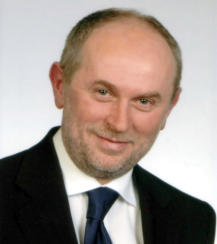
Janusz Ostrowski
Board of the International Association for the History of Nephrology




President - Davide Viggiano
PAST President - Ayse Balat
TREASURER - Vincenzo Savica
EX OFFICIO - Natale De Santo
INTRODUCTION
Professor, Department of the History of Medicine,
Centre of Postgraduate Medical Education, Warsaw, Poland
janusz.ostrowski@cmkp.edu.pl
Janusz Ostrowski
Artificial
intelligence
(AI)
is
often
generating
overwhelming
enthusiasm,
framed
as
a
revolutionary
force
in
modern
society,
but
also
deep
doubts
that
the
huge
investments
in
these
platforms
are
generating
a
frightening
speculative
bubble.
Though
the
economical
aspects
are
far
from
the
short
analysis
here
presented,
one wonders whether its introduction in the humanities is happening too soon and with excessive expectations.
I
argue
that
AI
introduces
novel
methods
for
analyzing
medical
history,
with
three
limitations:
deep
contextual
interpretation,
critical
source
engagement,
and
ethical vigilance. We must examine also the epistemological tensions AI introduces.
The
Turing
Test
(1950),
introduced
to
test
if
a
machine
is
intelligent,
prioritizes
superficial
mimicry.
Translated
in
the
history
field,
a
Turing
test
on
AI
would
aim
at
verifying
if
a
machine
has
depth
of
understanding
and
knowledge
that
historical
interpretation
requires.
The
first
AI
device,
the
perceptron,
was
theoretically
described few years later by Rosenblatt (1957), and was inspired by neurons, with a reduction of biological complexity to binary.
Artificial Intelligence in the History
of Nephrology: Challenges, Limitations, and Criticism
Guido Gembillo
Katarina Derzsiova
Vincenzo Savica
Ioannis Stefanidis
Murat Aksu
Abdullah Yildiz
Mario Lamagna
Councillors:
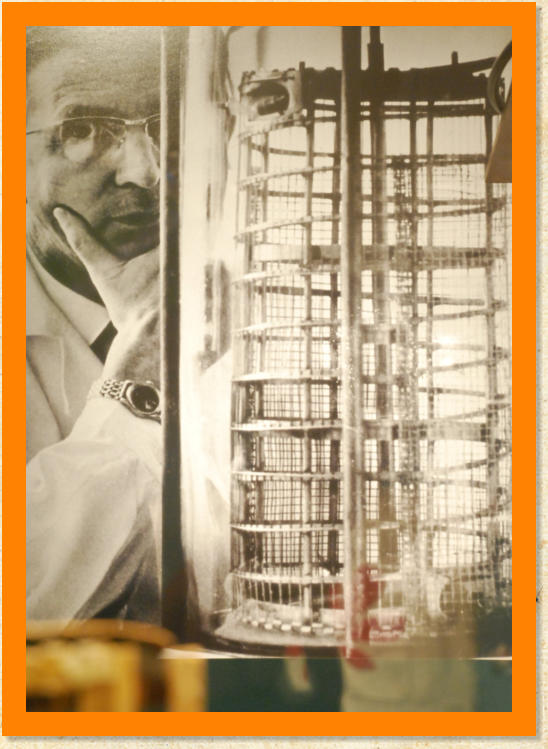
Medical history exhibition in Lund, Sweden. Nils Alwall. Photo. Janusz Ostrowski
Janusz Ostrowski




Department of Translational Medical Sciences,
Univ. of Campania “L. Vanvitelli”, Naples, Italy
Davide Viggiano
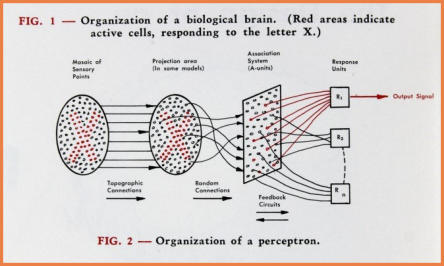
Figure 1. Rosenblatt's “The Design of an Intelligent Automaton,” (1958), describing
the perceptron (taken from https://news.cornell.edu/stories/2019/09/professors-
perceptron-paved-way-ai-60-years-too-soon )
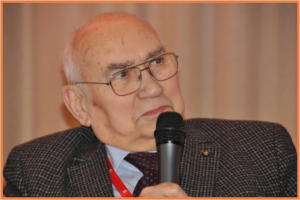
Figure 1. Prof. Bolesław Rutkowski
(photo Janusz Ostrowski)
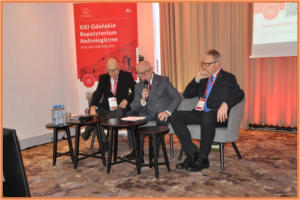
Figure 2. Scientific session. From left: prof.
Bogdan Biedunkiewicz (Gdańsk), prof. Janusz Ostrowski,
prof. Marcin Renke (Gdańsk) (phot. Maria Ostrowska)
Contents
Janusz Ostrowski
INTRODUCTION
Davide Viggiano
Artificial Intelligence in the History of Nephrology: Challenges, Limitations, and Criticism
Davide Viggiano
IAHN Activities through its Bulletin and Congresses: A Chronicle from 2008 to 2024
Janusz Ostrowski
Polish Nephrology in 2025: Key Events and Contributions of IAHN Members
Davide Viggiano
Books in History of Medicine worth having a look Histoire de la médecine (2020) — Jean Starobinski
The
simplification
of
complex
biological
phenomena
in
binary
codes
is
a
persistent
issue
in
AI
applied
to
the
history
of
nephrology:
flattening
context-rich
human
phenomena
into
computable
data.
This
stems
at
the
heart
of
a
strong
resistance
to
the
use
of
AI
in
historical
work:
the
neophobia
that
AI
might
produce
convincing but hollow narratives in medical history seems to resurrect age-old dilemmas about artifice and authenticity.
However, several criticalities in AI can be identified:
1
.
Machine
learning
models,
including
transformers
like
BERT
or
GPT,
excel
at
identifying
statistical
patterns,
correlations
in
text
but
lack
a
model
of
historical
reality
or
a
world
model.
For
instance,
an
NLP
tool
might
associate
“humoral
imbalance”
with
“treatment”
across
a
corpus
of
17th-century
texts,
but
it
cannot
access
the
embodied
experience,
beliefs,
or
social
hierarchies
that
gave
those
terms
meaning.
The
algorithm
could
not
discern
metaphor
from
clinical
description. This is not a mere data problem but an ontological one.
2
.
AI
can
systemically
exacerbate
the
issue
of
biased
sources.
Models
trained
on
digitized
collections
will
overrepresent
the
published
works
of
elite,
male,
Western physicians. Therefore, an AI might systematically overlook the lay knowledge and patient experiences, which are less frequently digitized.
3
.
The
“black
box”
problem
(nobody
can
tell
how
an
AI
has
produced
the
results)
is
particularly
acute
for
historiography,
which
relies
on
transparent
argumentation. The use of AI thus risks creating a new form of scholarly authority that is inherently unverifiable.
4
.
The
ethical
landscape:
medical
records,
even
historical
ones,
contain
sensitive
information.
AI-driven
linkage
of
disparate
archives
could
reconstruct
intimate
health details of identifiable individuals from centuries past, raising questions about posthumous privacy and the ethics of digital resurrection.
5
.
Generative AI poses a unique threat: the fabrication of plausible but false historical data.
6
.
Proprietary AI models (like those of Google or OpenAI) are often trained on publicly funded digitization projects, yet their outputs remain commercial.
In
summary,
the
historian
skepticism
towards
AI
is
based
on
valid
epistemological
concerns.
It
remains
to
be
ascertained
if
an
AI,
overall,
is
really
worse
than
all
expert human beings concerning methodological rigor, openness to ambiguity, contradiction, and source criticism.
I
believe
that
the
true
value
of
AI
for
the
history
of
nephrology
does
not
lie
in
the
unmet
promise
to
solve
any
as
yet
unsolvable
historical
mystery,
but
in
its
help
in
giving support to reasoning and analysis: AI as a companion rather than a substitution for a skilled historian.
The
IAHN
Bulletin
started
in
December
2018,
thanks
to
the
great
work
of
the
Editor-in-Chief
Janusz
Ostrowski.
Since
then,
the
Bulletin
has
appeared
twice
per
year
.
The
Bulletin
of
IAHN
is
also
present
on
the
website
of
the
European
Renal
Association
(ERA).
Many
IAHN
members
have
contributed
to
the
contents
of
the
Bulletin.
Being
a
production
of
the
IAHN
community,
the
themes
addressed
within
the
Bulletin
represent
the
core
of
the
IAHN
work,
together
with
the
full
length
publications that have regularly appeared on international journals after every biannual IAHN meeting.
IAHN Activities through its Bulletin
and Congresses: A Chronicle from 2008 to 2024
Janusz Ostrowski



Department of Translational Medical Sciences,
Univ. of Campania “L. Vanvitelli”, Naples, Italy
Davide Viggiano
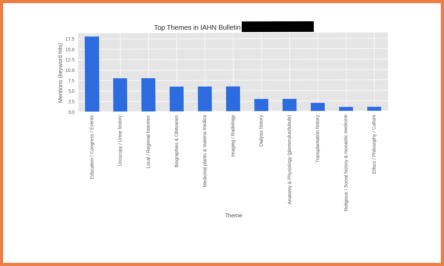
Figure 1. Top themes in IAHN Bulletin
Figure
1
reports
a
first
analysis
regarding
the
contents
of
the
Bulletin.
Information
regarding
events
is
likely
the
most
present
item.
However,
specific
themes
are
also evident: history of urine analysis, biographies, obituaries, medicinal plants, hemodialysis, transplantation etc.
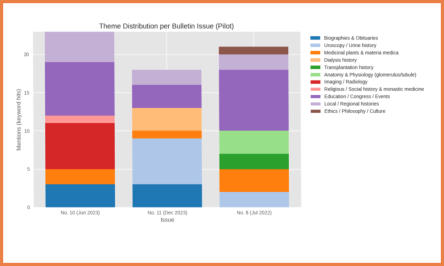
Figure 2. Themes by Issue (only three issues shown)
In
Figure
2
the
various
themes
are
analyzed
across
different
issues:
it
is
evident
that
there
is
much
heterogeneity.
Since
2024
we
have
stably
introduced
a
section
of books. Description of biographies are certainly a constant during the activity of the IAHN.
Regarding the evolution of the themes, the last issue in Dec 2024 is shown in Figure 3.
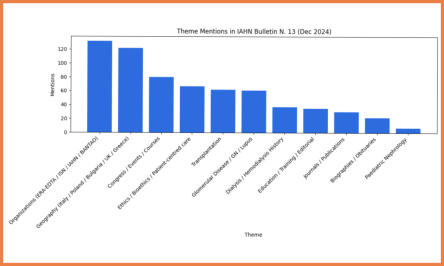
Figure 3. Themes treated in the last Bulletin 2024.
Apart
the
organization
of
events,
which
was
already
a
main
theme
in
previous
issues
(and
will
likely
become
a
fixed
section
of
the
Bulletin),
there
is
possibly
greater attention towards history of methods/nosology compared to biographies.
This evolution of themes can also be appreciated from the topics addressed in IAHN congresses.
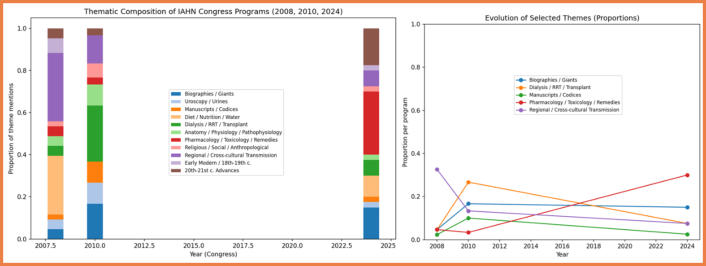
Figure 4. Themes at IAHN congresses
Figure
4,
again,
stresses
the
changes
in
the
major
themes
addressed
by
IAHN
community
of
the
years.
Biographies/giants
of
nephrology
remains
a
rather
constant
theme.
However,
pharmacology/remedies
now
receive
greater
attention
maybe
due
to
the
recent
introduction
of
many
new
drugs
in
the
treatment
of
kidney
diseases (glyfozines, HIF stabilizers, GLP-1 agonists, finerenone, and all the new monoclonal antibodies).
The
analysis
of
IAHN
congress
programs
from
2008,
2010,
and
2024
shows
a
clear
thematic
evolution.
Early
congresses
(2008,
2010)
emphasized
classical
historical
topics
such
as
biographies,
uroscopy,
and
manuscripts,
reflecting
a
strong
focus
on
pioneers
and
ancient
practices.
By
2024,
themes
related
to
clinical
nephrology,
dialysis,
and
transplantation
gained
prominence,
indicating
a
shift
toward
integrating
historical
perspectives
with
modern
nephrology.
Cultural
and
social
history
remained
present
but
less
dominant,
while
educational
and
interdisciplinary
themes
emerged
more
recently.
This
trend
suggests
that
the
IAHN
has
progressively
broadened its scope to include contemporary clinical relevance and global cultural dimensions.
For
years,
the
final
issue
of
the
IAHN
Bulletin
has
featured
an
overview
of
the
activities
of
our
Polish
members
during
the
country’s
key
annual
nephrology
conferences.
The
first
major
event
of
2025
took
place
just
after
New
Year’s:
the
21st
Gdańsk
Nephrology
Review
–
Post-ASN
Meeting,
held
on
10–11
January
in
Gdańsk.
The
conference
aims
to
bring
the
latest
nephrology
insights
directly
from
the
American
Society
of
Nephrology
Congress,
which
takes
place
two
months
earlier in the United States.
For
21
years,
the
meeting
has
been
organised
by
our
colleague
and
IAHN
Honorary
Member,
one
of
Poland’s
most
distinguished
nephrologists,
Prof.
Bolesław
Rutkowski
(Fig.
1).
This
year’s
programme
included
five
thematic
sessions
on
the
physiological
and
pathophysiological
basis
of
kidney
diseases,
advances
in
clinical
nephrology,
new
developments
in
dialysis
therapy,
various
topical
issues,
and
innovations
in
kidney
transplantation.
Prof.
Rutkowski
and
I
chaired
the
scientific
sessions,
while
Prof.
Andrzej
Więcek
—
another
IAHN
Honorary
Member
—
delivered
a
lecture
on
iron,
erythropoietic
agents,
and
hypoxia-inducible
factor
inhibitors in chronic kidney disease. It was an exceptionally successful meeting (Fig. 2.). The 22nd edition is already scheduled for January 2026.
Janusz Ostrowski




Polish Nephrology in 2025: Key Events
and Contributions of IAHN Members
Professor, Department of the History of Medicine,
Centre of Postgraduate Medical Education, Warsaw, Poland
janusz.ostrowski@cmkp.edu.pl
Janusz Ostrowski
Another
major
event
was
World
Kidney
Day,
held
annually
in
Warsaw,
with
this
year’s
meeting
taking
place
on
14
March,
in
parallel
with
similar
initiatives
worldwide.
For
many
years,
the
event
has
been
organised
by
Prof.
Ryszard
Gellert,
head
of
the
Nephrology
Clinic
at
the
Centre
of
Postgraduate
Medical
Education
in
Warsaw
and,
until
recently,
Poland’s
National
Consultant
for
Nephrology
(Fig.
3.).
Prof.
Gellert
presented
the
2024
report
on
dialysis
therapy
in
Poland,
while
Prof.
Andrzej
Więcek
spoke
on
primary
prevention
in
kidney
diseases.
I
chaired
a
session
devoted
to
key
issues
in
dialysis
treatment.
The
event
concluded
with
a
panel
discussion (Fig. 4.).
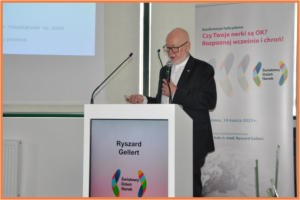
Figure 3. Prof. Ryszard Gellert (Warsaw)
(photo Janusz Ostrowski)
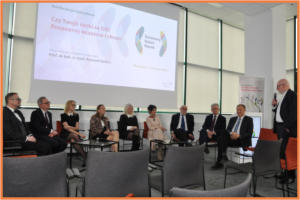
Figure 4. Panel session
(photo Janusz Ostrowski)
The
third
noteworthy
event
was
the
2025
Nephrocardiology
Scientific
and
Training
Conference,
held
on
4–5
April
in
Białystok.
The
conference
has
been
organised
for
more
than
a
dozen
years
—
initially
by
Prof.
Michał
Myśliwiec,
and
more
recently
by
Prof.
Beata
Naumnik,
Head
of
the
First
Department
of
Nephrology,
Transplantology
and
Internal
Medicine
with
the
Dialysis
Centre
at
the
Medical
University
of
Białystok
(Fig.
5).
The
coexistence
of
kidney
diseases
—
particularly
chronic
kidney
disease
—
and
cardiovascular
disorders
is
extremely
common,
which
explains
the
strong
interest
the
conference
attracts
among
nephrologists
and
cardiologists
alike
(Fig.
6.).
The
programme
featured
lectures
by
many
distinguished
experts
from
across
Poland.
I
had
the
honour
of
taking
part
in
a
debate
entitled
“Men
are
from
Mars,
Women
are
from
Venus?”,
which
addressed,
among
other
topics,
the
role
of
women
in
nephrology
and
the
nephrological
challenges
in the care of female patients.
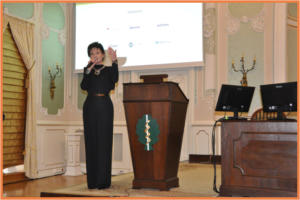
Figure 5. Prof. Beata Naumnik (Białystok)
(photo Janusz Ostrowski)
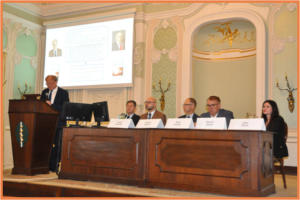
Figure 6. Prof. Andrzej Januszewicz (Warsaw),
cardiologist, during a lecture (photo Janusz Ostrowski)
The
most
important
nephrology
event
in
Poland
in
2025
was
the
15th
Congress
of
the
Polish
Society
of
Nephrology,
held
in
Katowice
from
12–14
June.
The
Scientific
Chairs
of
the
Congress
were
Prof.
Marcin
Adamczak
(Fig.
7.)
and
Prof.
Magdalena
Krajewska,
President
of
the
Society,
with
Prof.
Andrzej
Więcek
serving
as
Honorary
Chair.
The
Scientific
Committee
prepared
a
rich
and
engaging
programme
of
lectures
and
workshops
covering
many
aspects
of
contemporary
nephrology.
Among
the
participants
were
all
leading
figures
in
Polish
nephrology,
as
well
as
a
special
guest,
Prof.
Peter
Stenvinkel,
an
Honorary
Member
of
the
Society, who delivered a lecture entitled
“Learning from nature to make everyone healthier – a concept of planetary health.”
During
the
opening
ceremony,
I
was
delighted
to
accept
the
title
of
Honorary
Member
of
the
Polish
Society
of
Nephrology
(Fig.
8.)
and
to
present
a
lecture
entitled
“The
History
of
Silesian
Nephrology.”
One
of
the
main
items
on
the
agenda
was
the
election
of
the
Society’s
leadership
for
the
2025–2028
term.
Prof.
Marcin
Adamczak,
representing
the
Department
of
Nephrology,
Transplantology
and
Internal
Medicine
at
the
Medical
University
of
Silesia
—
and,
as
of
this
year,
a
member of the Council of the European Renal Association (ERA) — was elected as the new President (Fig. 9, 10).
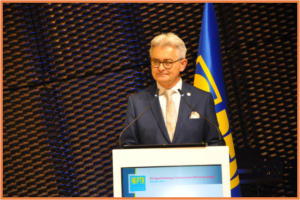
Figure 7. Prof. Marcin Adamczak during opening
ceremony (photo Janusz Ostrowski)
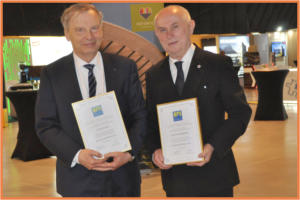
Figure 8. New honorary members of the Polish Society
of Nephrology. From left: prof. Jan Duława (Katowice),
prof. Janusz Ostrowski (photo Maria Ostrowska)
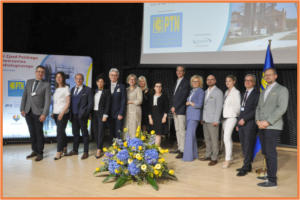
Figure 9. New Board of the Polish Society of Nephrology
(photo Janusz Ostrowski)
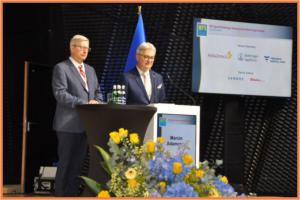
Figure 10. From left: prof. Andrzej Więcek,
prof. Marcin Adamczak
(photo Janusz Ostrowski)
The
final
major
nephrology
event
in
2025
was
the
25th
Katowice
Seminar
“Advances
in
Nephrology
and
Arterial
Hypertension”
,
held
from
27–29
November.
The
Seminar
has
been
organised
continuously
since
2001
by
Professor
Andrzej
Więcek
(Fig
11.).
This
three-day
meeting
brings
together
specialists
in
nephrology,
cardiology,
hypertension,
diabetology,
and
related
medical
fields.
Over
the
years,
nearly
250
speakers
have
taken
part,
including
many
on
multiple
occasions
(Fig.
12,
13).
Among
them
have
been
IAHN
members
such
as
Professors
Natale
De
Santo,
Garabed
Eknoyan,
and
Biagio
Ricciardi,
as
well
as
numerous
representatives
of
ERA-EDTA (now ERA), including Carmine Zoccali, Francesco Locatelli, Eberhard Ritz, and Shaul Massry.
I
had
the
pleasure
and
honour
of
delivering
a
lecture
entitled
“25
Years
of
the
Katowice
Seminars
–
Memories
of
Selected
Distinguished
Speakers.”
The
Katowice
Seminar
remains
one
of
the
most
prestigious
scientific
gatherings
in
Polish
nephrology
and
enjoys
great
popularity
among
younger
specialists
(Fig.
14).
We
hope
that, following this jubilee edition, Professor Więcek will continue this valuable initiative for many years to come.
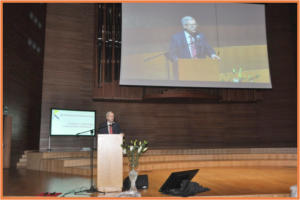
Figure 11. Prof. Andrzej Więcek
(photo Janusz Ostrowski)
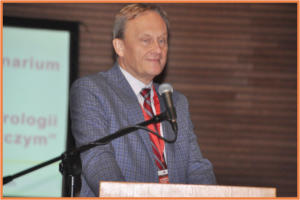
Figure 12. Prof. Michał Nowicki (Łódź) giving a lecture
(photo Janusz Ostrowski)
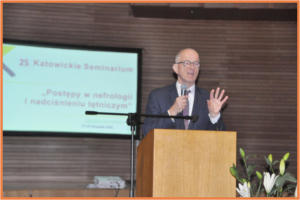
Figure 13. Prof. Reinhold Kreutz (Berlin, Germany)
during a lecture (photo Janusz Ostrowski)
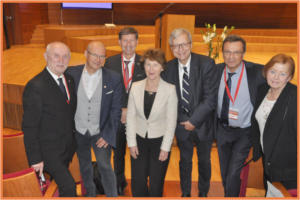
Figure 14. After a lecture. From left: prof. Janusz Ostrowski,
Tomasz Stompór (Olsztyn), Leszek Domański (Szczecin),
Teresa Nieszporek (Katowice), Andrzej Więcek,
Kazimierz Ciechanowski (Szczecin),
Beata Więcek (photo Maria Ostrowska)
I
hope
that
this
brief
overview
provides
a
clear
picture
of
the
development
of
Polish
nephrology,
the
contribution
of
nephrology’s
history
to
that
progress,
and
the
active role played by IAHN members. In 2026, all the conferences mentioned above will take place once again, joined by the biennial Kraków Dialysis Days.
Jean
Starobinski
(1920–2019)
has
been
one
of
the
most
distinguished
figures
in
Swiss
intellectual
life,
trained
both
as
a
physician
(MD,
1945)
and
as
a
historian
of
ideas.
A
professor
of
French
literature
at
the
University
of
Geneva
for
more
than
three
decades,
he
became
internationally
renowned
for
his
studies
on
Jean-
Jacques
Rousseau,
Montaigne,
and
the
history
of
melancholy
(see
e.g.
L'Encre
de
la
melancolie,
2012).
His
dual
formation
as
clinician
and
literary
scholar
gave
him
a unique vantage point on medical culture and its symbolic dimensions.
Published
posthumously,
"Histoire
de
la
médecine"
(2020)
grew
out
of
a
series
of
lectures
delivered
in
1999
at
the
invitation
of
his
colleague
Jean-Dominique
Bouvier.
Rather
than
producing
a
conventional
chronological
survey,
Starobinski
offers
a
sequence
of
elegant
reflections
on
the
long
arc
of
medical
development.
The book is deliberately concise—barely a hundred pages—yet remarkably rich in interpretive insight.
Starobinski’s
central
claim
is
that
the
history
of
medicine
is
not
merely
the
story
of
discoveries,
instruments,
and
therapeutic
advances.
It
is
equally—and
perhaps
primarily—the
history
of
the
changing
figure
of
the
physician
and
of
the
evolving
relationship
between
healer
and
patient.
This
anthropological
perspective
provides the thread that binds archaic healing rites to contemporary biomedical practice.
I
will
pick
up
just
a
few
of
the
inspiring
and
original
elements
described
in
the
book.
Starobinski,
for
example,
highlights
the
parallel
sacred
origins
of
medicine
in
figures
such
as
the
Egyptian
Imhotep
and
the
Greek
Asclepius.
He
also
draws
attention
to
a
striking,
often
neglected
dimension
of
pre-modern
therapeutics:
the
placebo
effect,
and
the
trust
on
which
it
depends.
With
characteristic
irony,
he
recalls
the
persistence
in
Europe
of
a
*Dreckapotheke*—a
pharmacopoeia
based
on
excrement—well
into
the
eighteenth
century.
Whatever
efficacy
such
remedies
had
was
rooted
almost
entirely
in
belief,
authority,
and
the
dynamics
of
the
physician–patient encounter. However, he adds that in many cases, modern drugs show greater efficacy depending on what is described in the depliant.
I
find
also
interesting
his
concerns
about
classifying
diseases.
Starobinski
notes
that
once
all
conditions
identifiable
through
simple
observation
had
been
catalogued,
further
progress
could
occur
only
through
new
investigative
tools.
The
rise
of
microscopy,
laboratory
diagnostics,
and
physiological
measurement
allowed
medicine
to
expand
its
catalogue
of
diseases
and
deepen
its
understanding
of
pathological
processes.
In
this
sense,
the
evolution
of
medical
nosology
mirrors the evolution of its instruments.
Turning
to
the
contemporary
era,
Starobinski
reflects
on
the
ethical
and
philosophical
implications
of
modern
medicine.
He
comments
on
the
emergence
of
a
“right
to
health,”
but
also
poses
a
disquieting
question:
medicine
has
become
extraordinarily
adept
at
extending
and
sustaining
life,
yet
it
satisfies
our
desire
to
live without helping us understand what we ultimately seek from life itself.
In
just
over
a
hundred
pages,
Starobinski
manages
to
connect
antiquity
with
modernity,
technical
progress
with
symbolic
meaning,
and
clinical
practice
with
existential
reflection.
*Histoire
de
la
médecine*
is
both
an
accessible
introduction
and
a
subtle
invitation
to
rethink
what
the
medical
profession
represents
today—a fitting capstone to a lifetime of humanistic inquiry.
Books in History of Medicine worth having a look
Histoire de la médecine (2020) — Jean Starobinski
Janusz Ostrowski




Department of Translational Medical Sciences,
Univ. of Campania “L. Vanvitelli”, Naples, Italy
Davide Viggiano